
Anyone can make a new layout look good. The brochure photos are shot before a single home goes up, the roads are freshly laid, the saplings are optimistically green. The harder question, and the only one that really matters for a plotted development in Bangalore, is what the place looks like ten or fifteen years later, once people have actually built and moved in.
We’d rather not ask you to take our word for that. We’d rather you go and see Windsong.
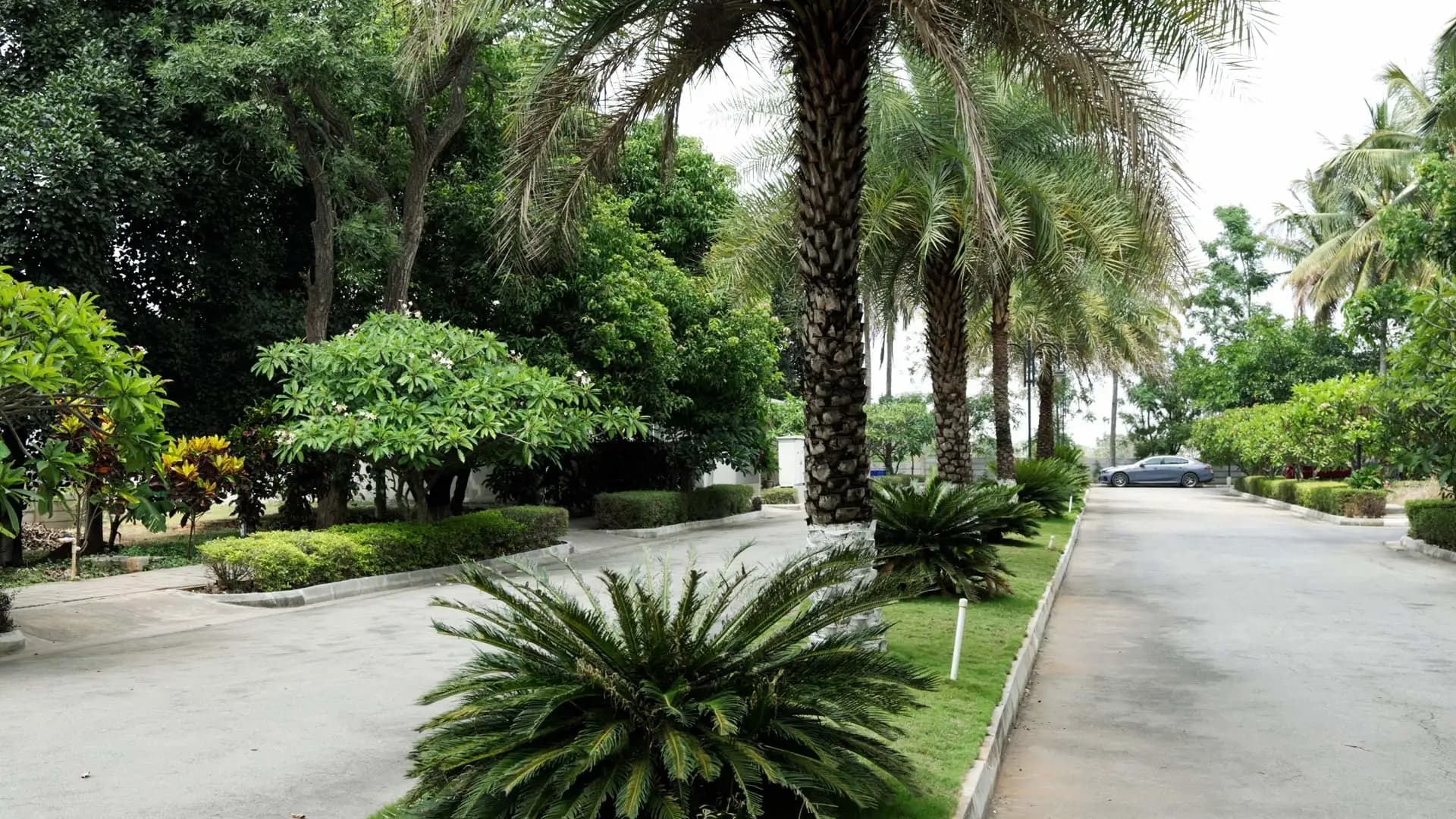
Windsong, 2011: the layout that still looks like itself
Windsong was our first project, back in 2011. Walk it today and the thing you notice is how little has gone wrong. The roads haven’t been dug up and patched a dozen times over. The footpaths aren’t broken. It still, more or less, looks like the layout it was drawn to be. That isn’t luck, and it isn’t the result of some heroic maintenance effort after the fact. It’s a set of decisions made once, correctly, before anyone moved in.
What fifteen years of plotted development in Bangalore taught us about the small stuff
In 2011, plotted development was nothing new to the city. Bangalore had been laying out sites for decades. What we did differently was treat the things you can’t see as seriously as the things you can. We were among the first developers here to run electrical lines underground and pre-lay pipe for utilities that hadn’t even arrived yet. You won’t spot the payoff on a site visit. It shows up as an absence: nobody spends the next ten years watching their road get torn open every time a new connection comes through.
Plot sizes have changed too, and not because of any design theory. We listened. Our early layouts leaned large, four and five thousand square feet. As land prices climbed across the city, a big group of buyers started asking for something more sensible: a 1,200 to 1,800 square foot plot that was still part of a proper, gated community. So that’s what we built. Premium never really meant big. It meant thought-through, whatever the size.
On Driveway Ramps
Some of the lessons were almost embarrassingly small. Driveway ramps, for one. Most layouts don’t build a ramp into each plot, so when a family finally builds their home, they break the footpath to make their own. One plot, no problem. A hundred plots all doing the same thing over a few years, and a layout that was beautiful on paper starts to look stitched together. So we build a ramp into every plot from the start. It’s an invisible decision. It also happens to be Vastu-friendly, which matters to a lot of our buyers.
The road that still doesn’t flood
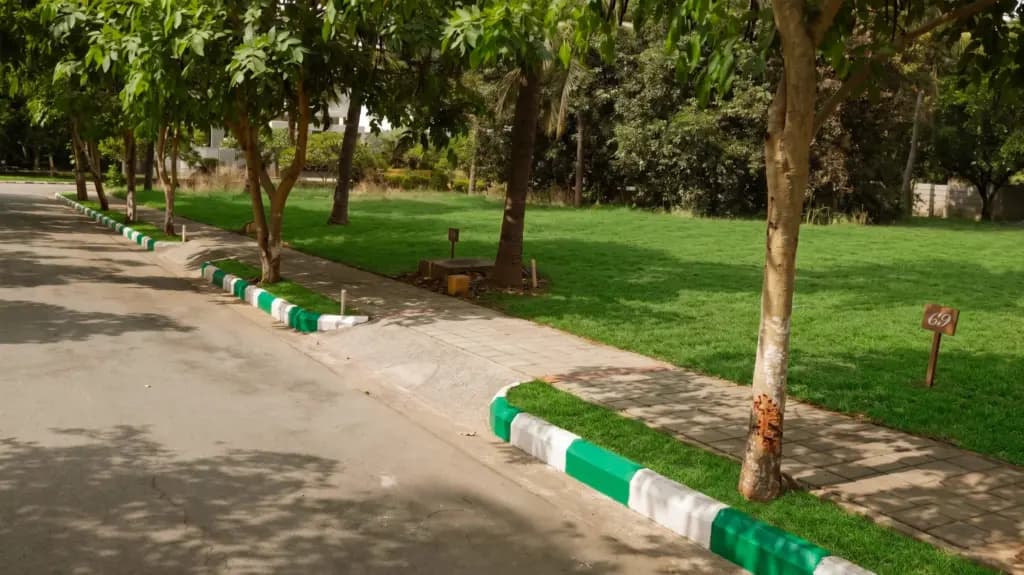
Ask what actually makes a Chartered road different and the honest answer is a bit of a letdown. There’s no secret mix. We just do each step properly instead of saving money on one of them.
Most Bangalore roads that flood, or that need digging up every couple of years, fail for the same reason: they were laid without respecting the natural slope of the land. Get the gradient wrong and water has nowhere to go. It pools, it sits, and standing water quietly eats a road from the surface down. Our layouts are engineered with consultants who work out the correct fall for every stretch, so rain moves, within minutes, into drains and recharge pits built to carry it off. Nobody on a first site visit asks about slope calculations. But that one unglamorous decision is most of the reason a Chartered road can still look new after a decade while others crack after a couple of monsoons.
The part almost every buyer forgets: maintenance
Most people don’t think about this bit when they buy a plot. They don’t build right away. Plenty of buyers wait years before construction starts, and in that gap, with nobody actually living there, an unmaintained layout goes downhill fast. Weeds, silted drains, dead lights, patchy security.
Since Windsong in 2011, we’ve collected five years of maintenance upfront from every buyer. Very few developers do this. It isn’t a glamorous line in a brochure. But it’s the reason a plot you buy today is in the same shape whether you build next year or in five: roads clean, landscaping intact, security on.
Why we bet on the SH-74 corridor near Nelamangala
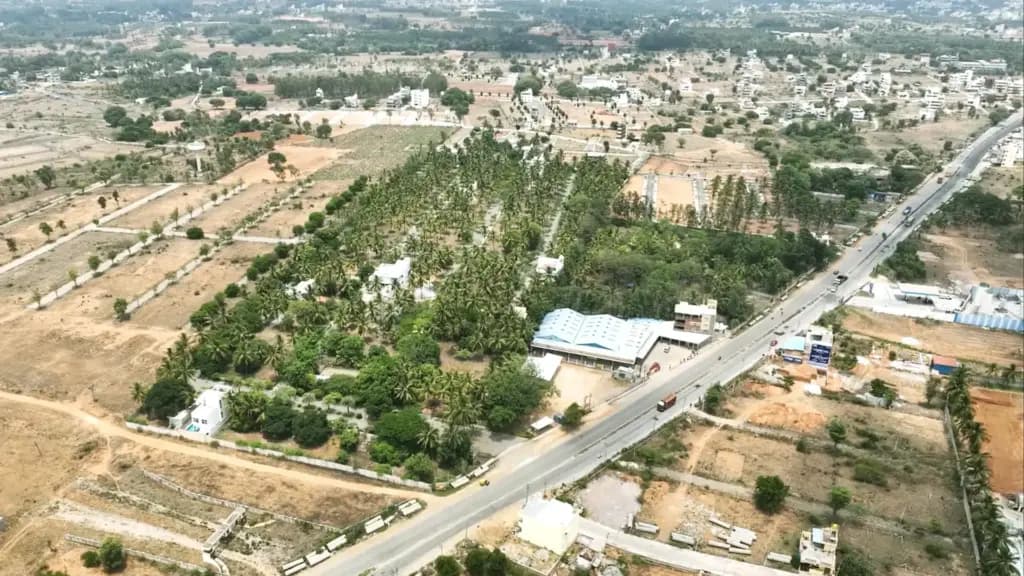
Look at North Bangalore and the pattern is clear: build the infrastructure, and growth follows.
It’s happening again along the Nelamangala–Doddaballapura road (SH-74), which feeds directly into Tumkur Road. The signs are everywhere — the highway expansion nearing completion, the industrial hub booming at Dabaspet, Tumkur is rising into a city of its own.
As the gap between Tumkur and Nelamangala closes, this corridor is set to gain.
The numbers make the case:
| Location | Average Price/Sq.Ft |
| North Bangalore | * ₹9,000 – 10,000 |
| SH-74 corridor, Nelamangala–Doddaballapura road | * ₹4,000 – 5,000 |
For long-term investors, that gap is the whole opportunity.
And this is where our older layouts do the selling for us. Chartered Veda, our layout project in this same corridor, launched in 2016 at ₹1,800 / sq. ft. – has already proved the thesis.
Resales there today go for well above that first-launch price, and consistently at a premium over neighbouring layouts, mostly on the strength of build quality. That isn’t a projection in a brochure. It’s what people are actually paying, today, for a Chartered layout that’s been standing long enough to judge.
What we tell every buyer to check
Fifteen years in, we’ve formed some blunt opinions about what any buyer should check, in a Chartered layout or anywhere else.
- The paperwork
A plot that’s a little cheaper is rarely worth it if the title isn’t completely clean. Land is a long-term asset, and clear ownership matters far more than a small saving today.
- What’s actually built into the ground
Roads, footpaths, drainage, kerbstones, paver blocks. It’s easy to print “premium” on a page. It’s much harder to lay road gradients that still hold up ten years on.
- Maintenance
Ask who keeps the layout up in the years before homes come, and how it’s paid for. That single answer tells you more about the next decade than any amenity list will.
If you’re weighing residential plots near Nelamangala, the honest advice is the same advice we followed ourselves seven years ago: don’t decide from a brochure. Walk the corridor.
The standard that stays invisible
None of this — the underground lines, the ramps, the gradients, the maintenance — is meant to impress you on the first walk-through. That’s rather the point. A good layout isn’t built to win a site visit. It’s built to still be standing, still working, still worth living in, long after everyone’s stopped paying attention.
That’s the standard going into the ground at Chartered Gulmohar right now, before a single home comes up. And if you want to know whether we’ll actually deliver it there, don’t take our word for it. Go walk one of our older layouts on the corridor, ask what’s underneath, and let a fifteen-year-old road make the case for us.
Frequently Asked Questions
Three things, in order. First, the title — a plot that is slightly cheaper is rarely worth it if ownership is not completely clean. Second, what is actually built into the ground: road gradients, drainage, kerbstones, footpaths. Third, maintenance — ask who keeps the layout up in the years before homes are built, and how it is paid for.
Go and look at an older layout by the same developer. A new layout always photographs well. A fifteen-year-old one tells you whether the roads still drain, whether the footpaths are intact, and whether anything has needed digging up since.
It means the maintenance cost for the first five years is collected at the time of purchase, so the layout is looked after whether or not owners have started building. Roads stay clean, landscaping stays intact, security stays on. Chartered has done this on every layout since Windsong in 2011.
RERA No.: PRM/KA/RERA/1250/307/PR/110226/008465